
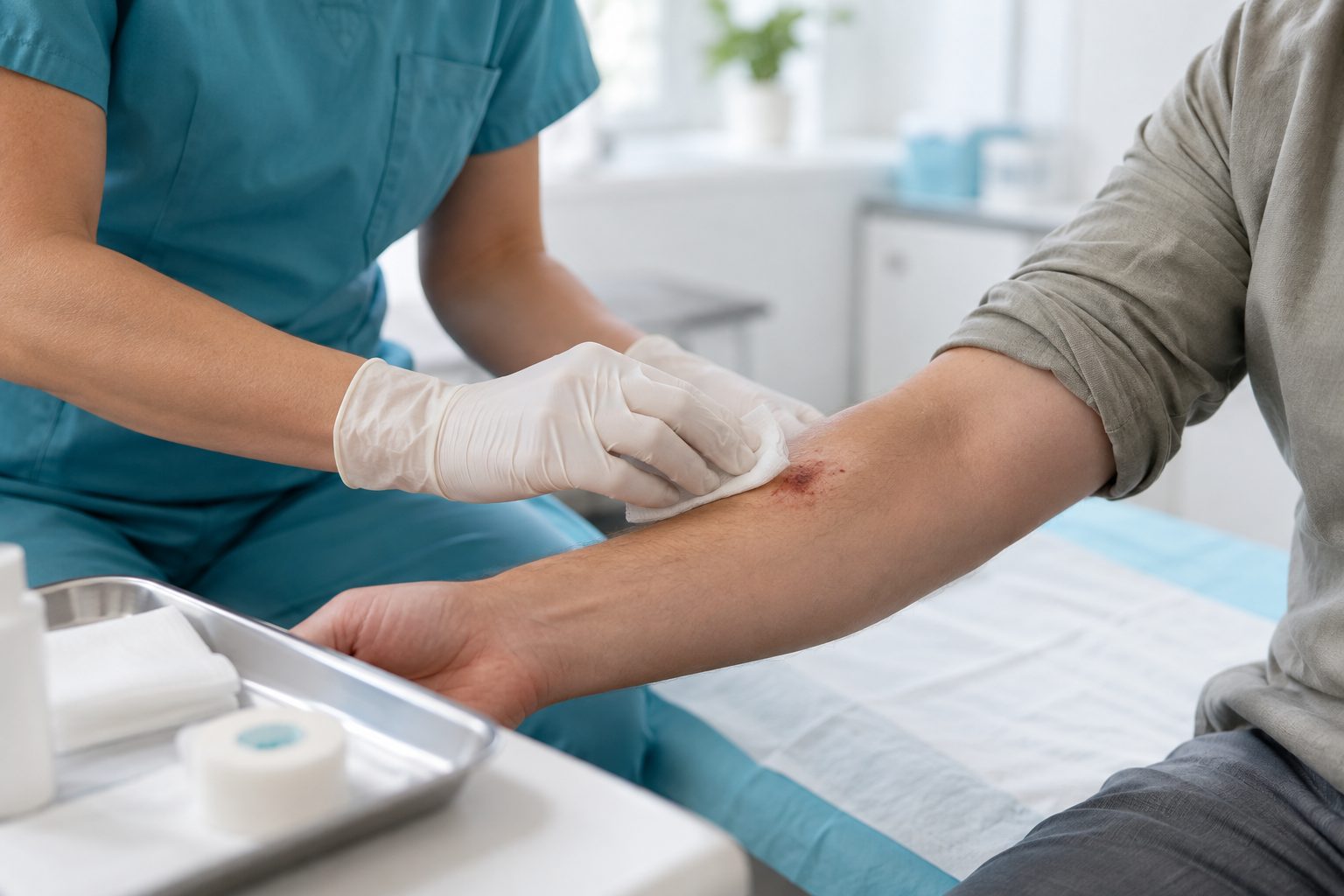
A scooter is how most people get around Bali, and many crashes here are low-speed. A wheel catches gravel on the shoulder of the road, or the front slides on a wet corner, and you are down before you can react.
Motorbike accident injuries follow a fairly consistent pattern, and the first 48 hours matter more than people expect. What happens in that time affects how the wounds heal, whether a fracture gets picked up, and whether an insurance claim goes through later.
The injuries a scooter fall usually causes
Low-speed falls produce a recognisable set of injuries, partly because riders here are often in shorts and sandals.
- Road rash across the shoulder, hip, elbow, knee and hands. It is often called a Bali tattoo, which understates how deep the grazes go.
- Wrist and forearm fractures from putting a hand out to break the fall.
- A broken collarbone from landing on the point of the shoulder, or injury to the small joint at the top of the shoulder.
- Burns to the calf or ankle from the exhaust pipe, easy to ignore at the scene and slow to heal.
- Ankle and foot injuries when a foot is caught under the bike, and deep knee wounds.
The first 48 hours
Get off the road, then work out what moves. Being able to move a limb does not rule out a fracture. People walk on broken feet for days because the pain is bearable.
A large, painful graze draws all the attention, and the fracture underneath it gets found a week later.
Cool an exhaust burn under cool running water for twenty minutes as soon as you can, and have it seen if it blisters, is larger than your palm, or sits over a joint.
Use ice, elevation and simple pain relief. Fracture pain usually peaks early and then eases. Pain that keeps climbing after 48 hours, or a wound that becomes redder and more painful after day two, is a reason to be seen again.
Road wounds heal differently in the tropics
Grazes from tarmac are not clean wounds. They carry grit, sand, road oil and fragments of plastic. Anything left behind delays healing and can leave permanent dark marks in the skin, so thorough cleaning often needs local anaesthetic.
Heat, humidity and sweat keep dressings damp, and a wound that would dry and scab at home stays wet here. Sea water, pools and rice paddies are all sources of contamination, the same problem that makes reef cuts so troublesome. Stay out of the water until the wound has closed.
A road wound is also tetanus-prone. If you do not know when you were last vaccinated, ask the doctor treating you about a booster.

X-rays, and the fractures that are easy to miss
An X-ray is warranted when there is tenderness over one specific point on a bone, when you cannot use or bear weight on the limb, when a joint looks out of shape, or when pain is not settling.
The scaphoid
The scaphoid is a small wrist bone in the hollow at the base of the thumb. It breaks in exactly the way scooter riders fall, on an outstretched hand, and often does not show on the first X-ray. Tenderness in that hollow is usually treated as a fracture until proven otherwise, with a splint and repeat imaging after ten to fourteen days. A missed scaphoid fracture can fail to heal, because that bone’s blood supply is easily disrupted.
Others easily missed on a first film include the radial head at the elbow, the base of the fifth metatarsal, and undisplaced cracks around the knee. Ankle injuries are often dismissed as sprains.
Fracture care, follow-up and paperwork
Treatment depends on which bone is broken, whether it has moved, and whether the joint surface is involved. Many fractures are managed in a cast, splint or sling. Plates, screws or wires are used when a fracture is unstable or displaced.
The follow-up review is the part travellers skip and the part that matters most. A fracture in a well-fitted cast can still shift in the first two weeks, and a repeat X-ray is how that is caught. Bone healing usually takes six to twelve weeks, and the stiffness afterwards needs rehabilitation.
Before you leave Bali, collect:
- The medical report, itemised receipts and copies of every X-ray or scan.
- A police report if one was made, plus photographs of the scene and the bike.
- Written confirmation of the treatment given and the follow-up advised.
Notify your insurer early and read the policy, because many exclude riding without a valid motorcycle licence or helmet.
Warning signs that need emergency care
Go to an emergency department, not a clinic, for:
- Loss of consciousness, confusion, repeated vomiting, or a headache that keeps worsening after a head injury.
- Neck or back pain after the crash, or numbness, tingling or weakness in an arm or leg. Do not move the person, and call emergency services.
- A limb that looks deformed, or a hand or foot that is cold, pale, numb or losing power.
- Severe and escalating pain in a swollen, tight limb, especially the forearm or lower leg, that is worse than the injury seems to justify, or pain on stretching the fingers or toes.
- Chest pain, difficulty breathing, or abdominal pain, particularly if it develops in the hours after the crash.
- Bleeding that will not stop with firm pressure, or a wound deep enough to show fat or bone.
- Pain that gets worse day by day rather than better, or fever with a spreading red wound.
Frequently asked questions
I only have road rash. Do I still need to see a doctor?
Yes. Grit left in a graze causes infection and permanent marking, and a large graze distracts from a fracture underneath it. A short visit for proper cleaning is worth the time.
How do I know whether my wrist is broken or only sprained?
Often you cannot. A broken wrist still moves, and swelling and bruising look much the same either way. Tenderness over one specific bony point, especially in the hollow at the base of the thumb, is a reason to have it X-rayed.
Can I fly home with a fresh cast?
Ask your treating doctor and your airline. Airlines commonly require a cast applied in the previous day or two to be split along its length to allow for swelling, and a long flight after a leg injury needs advice about clot risk.
How soon can I ride again?
It depends on the injury. Wounds need to be closed first, and a fracture needs to be stable enough that another fall would not undo the repair. Ask at your follow-up review rather than guessing.
Getting checked properly
Many scooter falls in Bali turn out to be more nuisance than disaster, once someone has checked for the things that are not. What turns a fall into a longer problem is an under-cleaned wound or a fracture nobody looked for. If something is not improving a few days after a crash, have it assessed. Our specialists consult at hospitals across Bali, and you can book a consultation or message us on WhatsApp.
This article is general information, not medical advice. Any persistent or severe symptom should be assessed by a qualified orthopaedic specialist in person.