
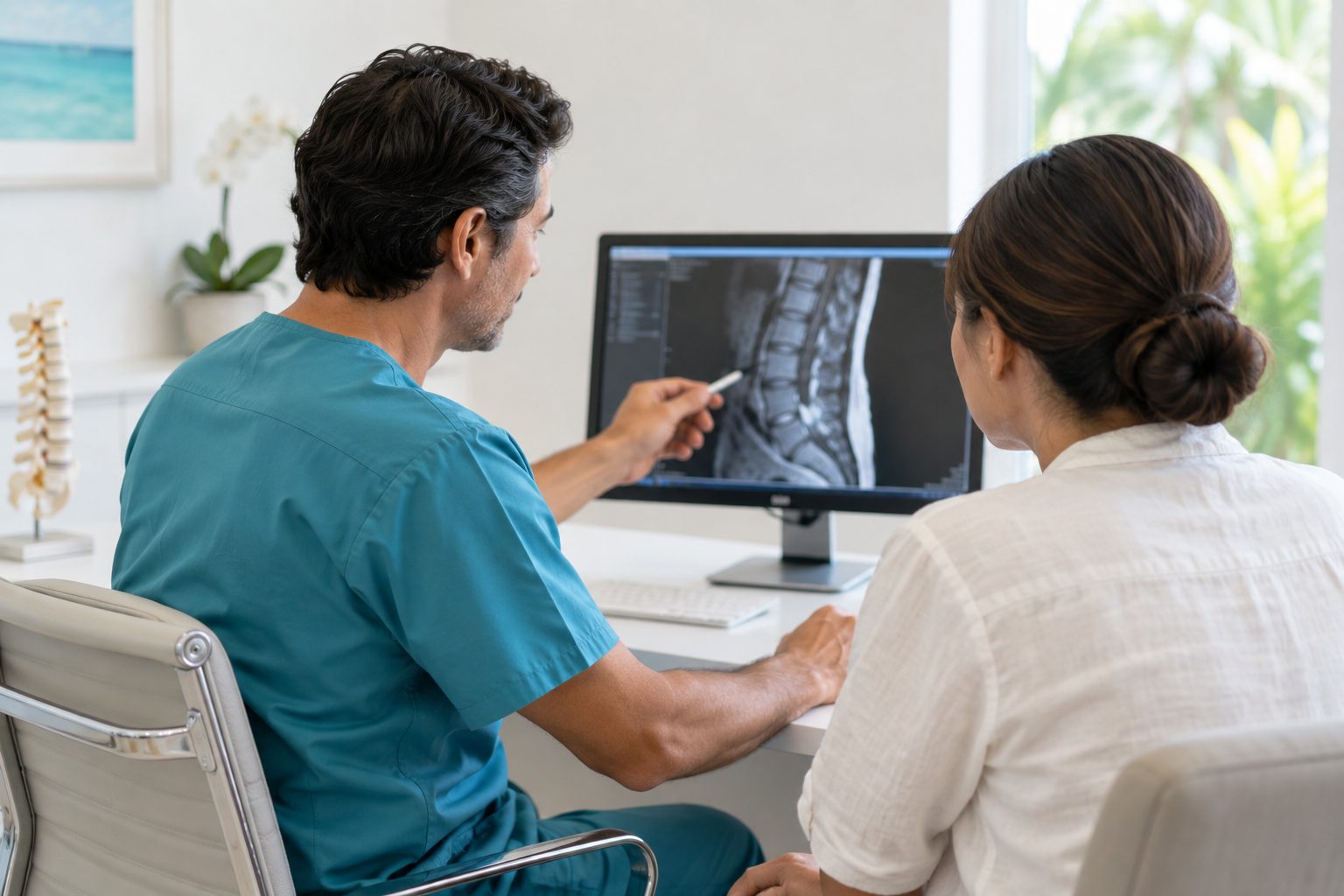
Being handed an MRI report full of words like herniation, protrusion and nerve root compression is unsettling. Most people reading one have had leg pain for a few weeks, have been told they have a slipped disc, and want to know how serious it is.
Herniated disc treatment is decided by what you can and cannot do, not by how the report reads. This article explains those words in plain terms, describes the pattern of a genuinely pinched nerve, and sets out how most cases behave over time and where surgery fits.
What the words on your MRI report mean
A disc sits between two vertebrae. It has a tough outer ring and a softer centre, and works as a spacer and a shock absorber. When the outer ring weakens, the softer material can push outwards.
- Bulge: the disc extends slightly past its normal edge all the way around. Very common with age.
- Protrusion: a more focal push outwards, where the base is wider than the part sticking out.
- Extrusion: material has pushed through the outer ring, so the escaped part is wider than its base.
- Sequestration: a fragment has separated from the disc completely.
- Annular fissure: a crack in the outer ring, common and often painless.
Size matters less than whether the disc actually touches a nerve root, and whether your symptoms match that nerve. Disc changes turn up regularly on scans of people who have never had back pain, so a report on its own is not a diagnosis.
What a pinched nerve actually feels like
In the lower back
Leg pain is usually worse than back pain, and it follows a line rather than spreading: down the back of the thigh into the calf and sole, or down the outer leg into the top of the foot. Numbness or tingling sits in one band. Coughing, sneezing and straining make it spike; sitting and bending forward make it worse, and lying flat often eases it.
In the neck
A cervical disc produces arm pain rather than leg pain, running from the shoulder blade into the arm and specific fingers. Turning or tilting the head towards the painful side usually makes it worse. Many people find that resting the hand on top of the head eases it.
Why many disc herniations settle without surgery
The body treats escaped disc material as something to clear away. Over the following weeks the fragment shrinks and inflammation around the nerve reduces. A large proportion of disc herniations improve over weeks to a few months with no operation, and larger extrusions often shrink more than small bulges.
Recovery is rarely a straight line. Pain usually improves before sensation, and numbness or slight weakness can take months to fade after the pain has gone.

The treatment ladder
Staying active and physiotherapy
Complete rest makes nerve pain worse, not better. A physiotherapist works on movement patterns, nerve mobility and the strength of the trunk and hip muscles, and adjusts the plan as symptoms retreat out of the leg towards the spine, which is a good sign.
Medication
Nerve pain often responds differently from ordinary muscular pain, so the medicines used are not always standard painkillers. Your doctor chooses them based on your symptoms and other conditions, and the aim is to make movement and sleep possible while the nerve calms.
Nerve root injection
A steroid injection placed under X-ray or CT guidance beside the irritated nerve root can reduce inflammation for weeks to months. It is used when pain is limiting normal life, and it also shows which nerve is responsible when the scan has more than one possible level.
Decompression surgery
The operation removes the fragment pressing on the nerve, not the whole disc. It can be done through a small incision with a microscope, through a tube, or with an endoscope, and it targets the leg or arm pain rather than the back pain itself.
What actually pushes a case toward surgery
Surgery is usually considered when nerve pain has not settled after six to twelve weeks of genuine non-surgical treatment, when pain is severe enough to prevent sleep and work, when weakness is significant or increasing, or when symptoms keep returning.
One condition applies throughout: the scan must match the examination. A disc that looks abnormal but does not explain your symptoms is not a reason to operate. A specialist will also ask how much your daily life has narrowed, because that, more than the images, decides whether an operation is worth it.
Warning signs that need urgent assessment
Some symptoms should not be given time to settle. Seek same-day or emergency assessment if you have:
- Numbness in the saddle area, difficulty passing urine, or loss of bladder or bowel control. These can indicate cauda equina compression, which is an emergency.
- Weakness that is clearly getting worse, such as a foot that drags or a leg that gives way.
- Sciatica-type pain in both legs at once, especially if it is new.
- With a neck disc, clumsiness in the hands, dropping objects, trouble with buttons, or a change in balance and walking.
- Fever, unexplained weight loss, or new nerve pain in anyone with a history of cancer.
Frequently asked questions
Can a herniated disc heal on its own?
Often, yes. The escaped material shrinks over weeks to months and the nerve settles, which is why most people never need an operation. Persistent weakness or unrelenting pain are the reasons to reconsider.
How long should I try physiotherapy before considering surgery?
Around six to twelve weeks of consistent treatment is the usual guide, assuming symptoms are improving. Surgery is discussed sooner if weakness progresses or pain is uncontrollable.
Will surgery fix my back pain as well as my leg pain?
Decompression targets the leg or arm pain caused by nerve compression, and that usually improves quickly. Back pain from the disc and surrounding joints is less predictable and may continue.
Can I exercise with a herniated disc?
Most people can, with adjustments. Walking, swimming and controlled strength work are usually fine, while heavy bending, twisting under load and long static sitting tend to aggravate symptoms early on.
Getting the pain explained
A disc problem with a clear pattern of nerve symptoms is one of the more treatable spine conditions, and the plan almost always starts well short of an operation. If your leg or arm pain has not improved after several weeks, or you want the report explained properly, our spine specialists consult at hospitals across Bali. You are welcome to book a consultation or message the clinic on WhatsApp.
This article is general information, not medical advice. Any persistent or severe symptom should be assessed by a qualified orthopaedic specialist in person.