
Lower back pain usually arrives without much warning. It might follow lifting a suitcase off a scooter, a long flight, a first surf session after months at a desk, or nothing you can point to. Some feel a sharp catch when they twist; others get a dull ache that builds through the afternoon.
Most episodes settle. Some keep going, and a very small number signal something that needs prompt attention. Telling those apart is the useful part, so this article covers the common causes, what helps early, and the signs that mean you should be seen quickly.
Three patterns worth telling apart
Nearly all back pain falls into one of three groups, and the group matters more than the label.
Mechanical pain stays in the back and buttock and changes with position. Bending or sitting too long makes it worse, and shifting posture eases it.
Nerve-related pain travels down the buttock and thigh, often past the knee, usually with pins and needles, numbness or weakness in one band. Most people call this sciatica.
Pain from a serious cause is uncommon. Infection, fracture, inflammatory spine disease and tumour do not follow the usual movement pattern, and other signs come with them.
What usually causes it in adults
Muscle and postural strain
Overloaded muscles tighten and stay tight for days. It hurts across the whole lower back, is worst on waking and after long sitting, and loosens as you move.
Disc problems
A disc can bulge or tear at its outer ring and irritate the nerve root beside it. That gives back pain plus one-sided leg pain, often worse when you sit, cough or sneeze.
Facet joint degeneration
The small paired joints at the back of the spine wear with age. Pain sits low and to one side, is worse leaning back or twisting, and stiff after rest.
Spinal stenosis
The space around the nerves narrows, usually after middle age. The clue is heavy, tired legs after walking a set distance, eased within a minute of sitting or leaning forward.
Referred pain from the hip or sacroiliac joint
Hip arthritis is often felt in the buttock and groin, not the hip. Sacroiliac pain sits just below the belt line on one side, worse when standing on one leg.

Why most episodes settle, and why an early scan often does not help
Backs are strong. Most episodes calm down over two to six weeks as irritated tissue settles and movement returns. Progress is uneven, and pain in that period does not mean you are doing damage.
Scans of adults with no pain at all often show disc bulges, dried-out discs and facet joint wear, and these increase with age. In the first weeks a scan rarely changes what happens next, while a report full of alarming words can make people move less. Imaging earns its place when there are warning signs, when nerve symptoms persist, or when an injection or surgery is being planned.
What actually helps in the first few weeks
- Keep moving in small doses. Several short walks a day beat one long walk, and both beat lying still. If you must sit, stand up every 30 minutes.
- Use heat for muscle tightness: a warm shower, or a heat pack for 15 to 20 minutes.
- Sleep on your side with a pillow between your knees, or on your back with a pillow under them.
- Ask a pharmacist or doctor which simple pain relief suits you. Its job is to let you stay active, not to switch the pain off.
- Rebuild in steps, adding a little distance or weight every few days rather than resting fully and then returning to everything at once.
When pain lasts past six weeks
At that point an assessment is worth having. It starts with detail: where the pain travels, what makes it better and worse, how it behaves at night, and what you have tried.
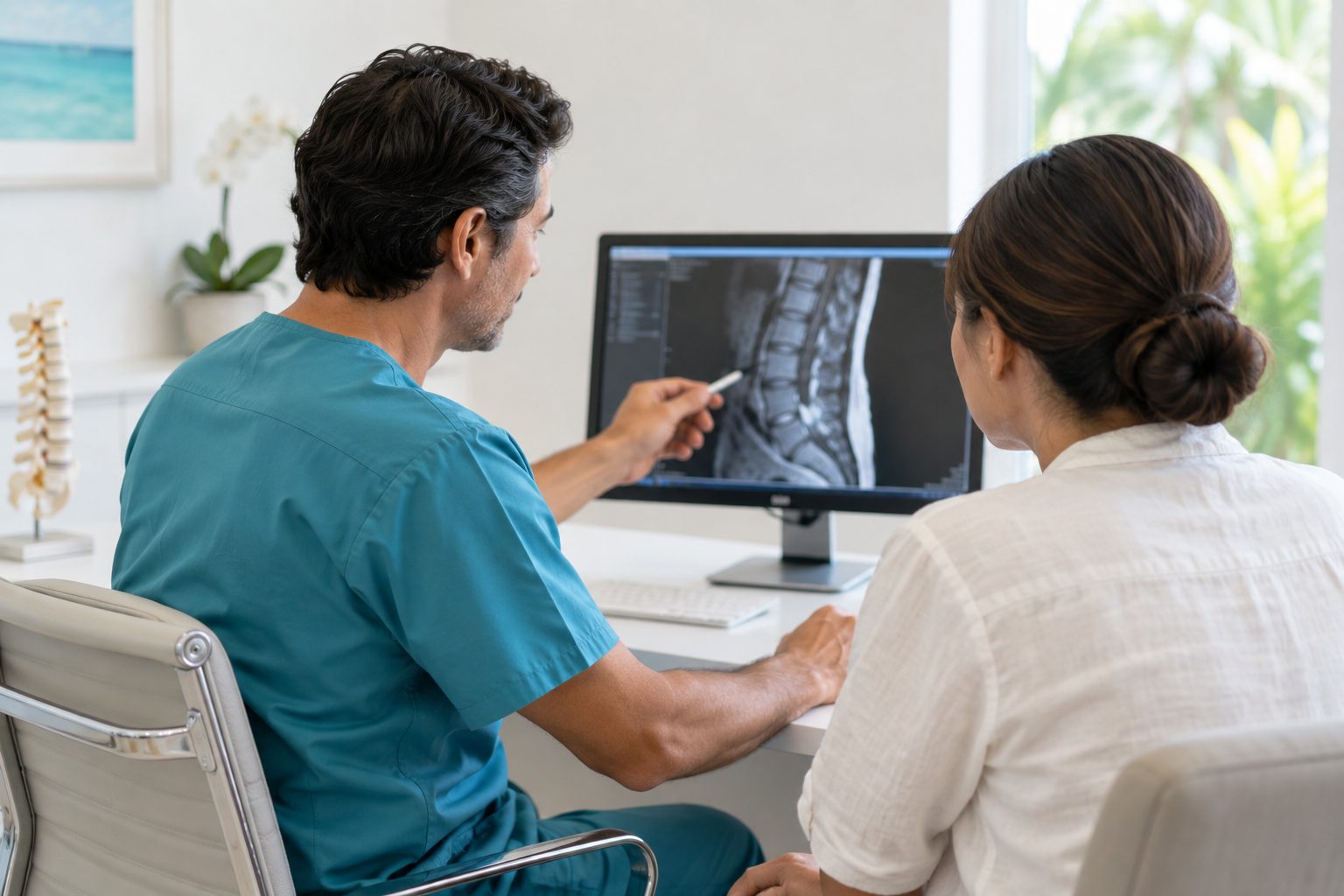
The examination checks spinal movement, power, reflexes and sensation in both legs, straight leg raise, the hips and how you walk. Imaging is targeted rather than routine: standing X-rays for alignment, MRI for the discs and nerves, blood tests if infection is possible. The plan is usually structured physiotherapy, sometimes a guided injection that treats the pain and shows which structure is responsible, and surgery only for problems such as nerve compression that has not settled.
Warning signs that need urgent assessment
Go to an emergency department, or arrange same-day review, if back pain comes with:
- Numbness in the saddle area, meaning the inner thighs, buttocks and the area you sit on, including reduced sensation when wiping.
- Loss of bladder or bowel control, or being unable to pass urine.
- Leg weakness that is getting worse: a foot that drags, a knee that gives way, or new difficulty on stairs.
- Fever or chills, or back pain soon after an infection or a medical procedure.
- Unexplained weight loss, or new back pain in anyone with a history of cancer.
- Constant pain that wakes you every night and does not change with position.
- Pain after significant trauma, such as a motorbike accident or fall from height, or after any fall in someone with thin bones.
- New, severe, tearing back or abdominal pain in anyone over sixty, which needs emergency assessment.
Frequently asked questions
How long should I wait before seeing someone about lower back pain?
If it is easing week by week, self-care and time are reasonable for four to six weeks. Come sooner if pain travels down the leg with numbness or weakness, or if any warning sign appears.
Is walking good or bad for lower back pain?
Walking usually helps. Start with short walks on flat ground several times a day. If pain rises sharply and stays high for hours afterwards, shorten the distance.
Do I need an MRI scan for my back?
Not for a typical first episode. It is most useful when leg symptoms persist beyond several weeks, when there is weakness, or when a procedure is being considered.
Can a mattress or pillow really make a difference?
The effect is real but modest. A mattress that is neither sagging nor rock hard suits most people, and pillow support under or between the knees often helps more.
Getting your back assessed
If your back pain has not improved after several weeks, travels into your leg, or keeps returning, an assessment can tell you what is driving it. Most people need nothing more than a clear explanation and the right rehabilitation plan. Our orthopaedic spine specialists consult at hospitals across Bali, and you are welcome to book a consultation or message the clinic on WhatsApp.
This article is general information, not medical advice. Any persistent or severe symptom should be assessed by a qualified orthopaedic specialist in person.