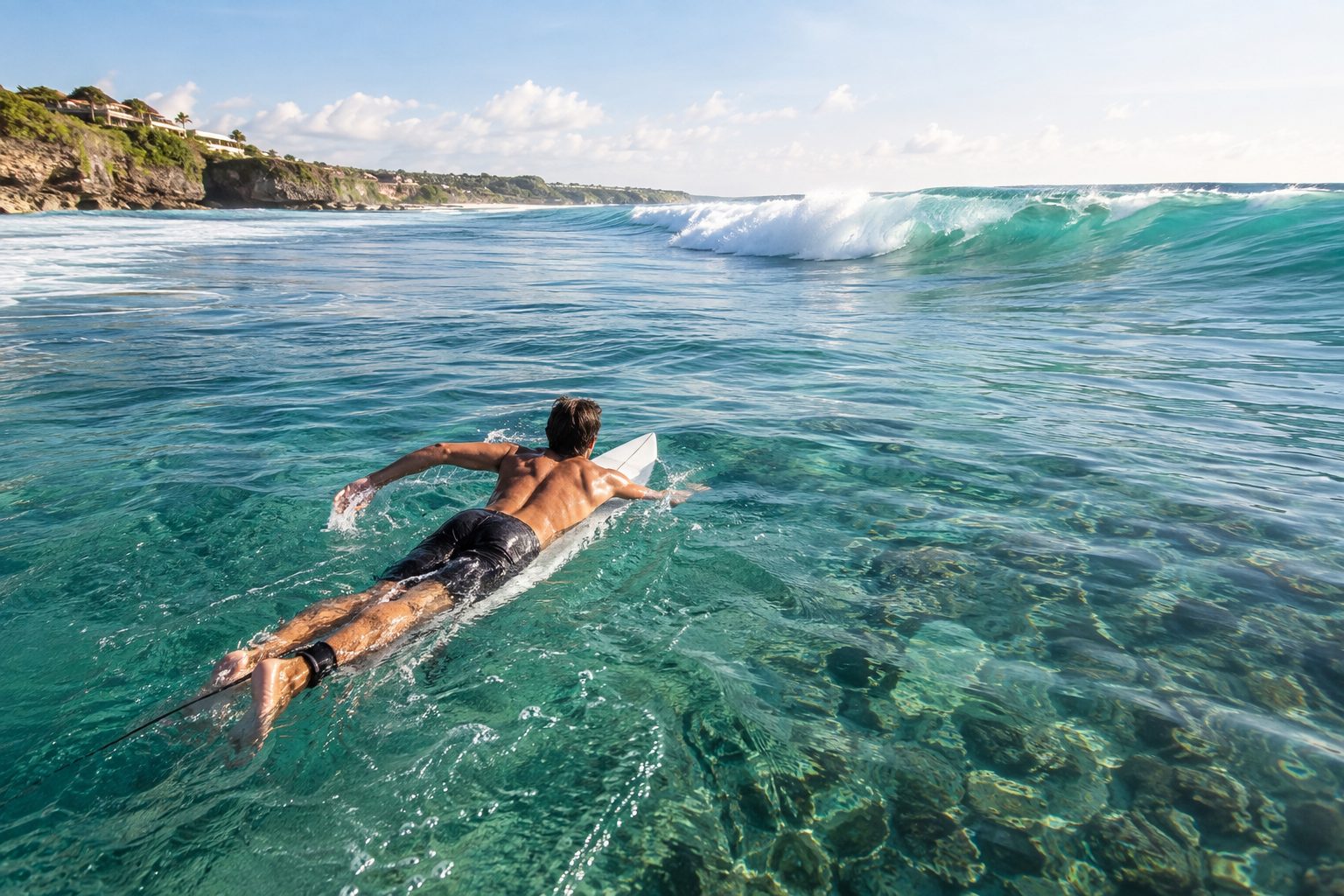
Bali has surfable waves year-round, from knee-high beach break to heavy reef. It draws people who surf twice a year and people who surf twice a day, into the same lineup.
Most surfing injuries here are not dramatic. They build up quietly over a few weeks of heavy paddling, or they happen in a second when shallow reef is involved. Much of it can be avoided.
Shoulder pain from paddling volume
Paddling is a very large number of repeated overhead strokes. A two-hour session at a long point break is thousands of them, and duck diving adds load at the front of the shoulder.
The usual result is rotator cuff irritation: pain at the front or outside of the shoulder, worse reaching overhead, and often worst lying on that side at night.
The biggest risk factor is a sudden jump in volume. Arriving after months out of the water, then surfing twice a day for a week, is how most visiting surfers end up with a sore shoulder.
Lower back pain from the paddling position
Lying on a board holds the lower back in extension for long stretches. The muscles either side of the spine and the small joints at the back of the vertebrae carry that load, and a long session leaves a dull ache that eases with rest.
Most of this settles with reduced volume and some hip and trunk strengthening. Pain that runs into the buttock or leg, or comes with numbness or weakness, is a different problem and should be assessed rather than trained through.
Knees, ankles and feet
Landing a drop or driving through a bottom turn loads the knee the way ligaments dislike. A knee that swells within hours and then feels unreliable when you turn on it needs looking at.
Ankles roll on landings and when stepping off a board onto uneven reef. An ankle that keeps giving way months later is treatable rather than bad luck, and worth having assessed.
A cut across the top of the foot or hand that stops a toe or finger moving may have caught a tendon. That needs to be explored, not simply closed.
Board strikes and the shallow reef hazard
In surfing generally, your own board causes more injuries than anyone else’s. Fins produce deep lacerations, the nose causes facial and dental injuries, and the rail breaks ribs and fingers. Crowded lineups at Uluwatu and Canggu add other people’s boards to the mix.
The serious injuries here involve reef rather than boards. Breaks along the Bukit such as Uluwatu, Padang Padang, Bingin and Impossibles sit over a reef shelf with very little water over it at low tide. Going over the falls head-first into shallow reef is one of the ways serious neck and head injuries happen here.
If someone takes a head-first impact and then has neck pain, numbness or weakness, keep them still, support their head, and get emergency help.
Reef cuts: the first hour matters
Coral cuts are not ordinary cuts. They push coral fragments, sand and marine bacteria into the wound, and warm tropical water suits infection. They become infected far more readily than the same cut would in a cooler climate.
- Clean the wound with fresh water as soon as you are out, not seawater.
- Rinse and clean the surface thoroughly with clean fresh water. Anything deeper than a graze, or any wound with fragments you cannot see the bottom of, needs cleaning by a clinician, often with local anaesthetic, rather than at home.
- Use a dilute antiseptic and cover with a clean dressing, changed daily.
- Stay out of the water until it has closed, because every session recontaminates it.
- Check when you last had a tetanus booster, and ask a doctor if you are unsure.
- Watch for spreading redness, pain increasing after day two, pus or fever.
Urchin spines that stay painful should be reviewed rather than dug at.

Reducing your risk
- Warm up before you paddle out: shoulder circles, thoracic rotations, hip openers. Going from a scooter seat straight into a two-hour session is how shoulders get sore.
- Build your paddling volume across your first week rather than surfing three times on day one.
- Match the break to your ability. A big low tide at Uluwatu is not the place to learn.
- Check the tide and depth first. Watch a few sets break, and ask someone who knows the spot.
- Wear reef booties at sharp reef breaks, and know where the exit is before you need it.
- On a wipeout, cover your head with your arms and come up looking. Never dive off the board head-first.
Warning signs that need urgent attention
Get seen the same day, or go to an emergency department, for:
- Head-first impact followed by neck pain, numbness, tingling or weakness in the arms or legs.
- Loss of consciousness, confusion, repeated vomiting or a worsening headache after a head strike.
- A limb that looks deformed, or that you cannot bear weight on or use at all.
- A wound that is deep, gaping, will not stop bleeding, or that stops a finger or toe moving.
- A wound that becomes hotter and more painful after 48 hours, or fever with a swollen joint.
Frequently asked questions
How long should I stay out of the water after a reef cut?
Until it has fully closed, which for a shallow cut usually means several days and longer for a deeper one. Surfing with an open coral wound is the most common reason a small cut becomes infected.
Will surfer’s shoulder settle on its own?
Often it will, if you cut your paddling volume early and add rotator cuff and upper back strengthening. Pain that lasts beyond a few weeks, wakes you at night, or comes with weakness should be examined.
I hit the reef with my head but felt fine. Should I get checked?
Yes, if you had any neck pain, tingling, weakness, confusion, or a moment where you were unsure what happened. Symptoms can appear hours later.
Do I really need reef booties in Bali?
They are worth wearing at sharp reef breaks and on reef entries and exits, where most foot cuts happen. They will not stop a heavy impact, so they are not a reason to surf beyond your level.
Getting back in the water
Most surf injuries in Bali are minor and manageable. What costs people a season is an ignored joint that keeps giving way, or an underestimated reef cut. If something has not settled as you expected, an assessment usually saves water time. Our specialists consult at hospitals across Bali, and you can book a consultation or message us on WhatsApp.
This article is general information, not medical advice. Any persistent or severe symptom should be assessed by a qualified orthopaedic specialist in person.