
Neck pain is a common complaint among people who work long hours on a laptop, and the way most people work in Bali makes it easy to acquire. The pattern is familiar: a laptop on a low café table, four hours without standing up, a long flight last week, and a villa pillow that is too thick.
Most of it responds to changes in how you sit and how often you move, rather than to treatment. This article covers what causes it, the fixes that work, and the symptoms that mean you should be examined rather than adjusting your desk again.
Why static posture is the real problem
Your head weighs about five kilograms. Holding it a few centimetres forward of your shoulders means the muscles at the back of your neck work continuously to stop it dropping.
The issue is less that posture is wrong and more that it never changes. Muscles held at low effort for hours fatigue, blood flow drops, and tender bands develop. That is why people with textbook posture still get sore. Movement, not perfect alignment, is what your neck is missing.
Setting up where you actually work
At a desk
- Raise the laptop so the top of the screen sits roughly at eye level, using a stand or a stack of books, then add an external keyboard and mouse. Without the keyboard, raising the screen only moves the strain to your shoulders.
- Keep the screen about an arm’s length away, and increase the text size rather than leaning in.
- Take a two-minute break every 30 to 45 minutes: stand, roll the shoulders back, gently draw the chin backwards, and look at something far away.
In a café or co-working space
Café tables are usually too low and the seating gives no back support, which pulls you into a slump. Choose a chair rather than a stool, rest your forearms on the table, and treat a café as a one to two hour spot, not a full workday. A folding stand and a compact keyboard in your bag fix most of it in seconds.
On a plane
Keep the device on the tray table rather than in your lap, and use a neck pillow that supports the sides so your head does not fall forward while you sleep. Get up every couple of hours on long flights.

Sleep, pillows and what you carry
A pillow should fill the gap between your ear and the mattress, keeping your nose in line with the middle of your chest. Side sleepers usually need a thicker pillow, back sleepers a thinner one. Sleeping on your stomach holds the neck turned to one side all night and is the position most likely to leave you stiff. In an unfamiliar bed, folding a towel inside the pillowcase adjusts the height in a moment.
Then there is what you carry. A single-strap bag loads one shoulder, so use both straps on a backpack, tighten them so the weight sits high, and swap sides often with a camera bag. Riding a scooter with a heavy pack adds hours of that same one-sided load.
Three kinds of neck pain, and how they differ
Muscular neck pain is a spread-out ache across the back of the neck and the top of the shoulders. It builds through the day, is worse after long screen sessions, and often has tender spots that ease with movement and heat.
Facet joint pain is one-sided and more localised. It sharpens when you turn your head or look up, is often worst on waking, and can refer up to the base of the skull or down to the shoulder blade.
Cervical radiculopathy means an irritated nerve root. The pain travels into the arm and often into specific fingers, with pins and needles, numbness or weakness. Turning towards the painful side makes it worse, and lifting the hand onto the head often eases it.
What an assessment involves when it persists
If neck pain has not improved after several weeks of sensible changes, or symptoms are travelling into an arm, an assessment is worth having.
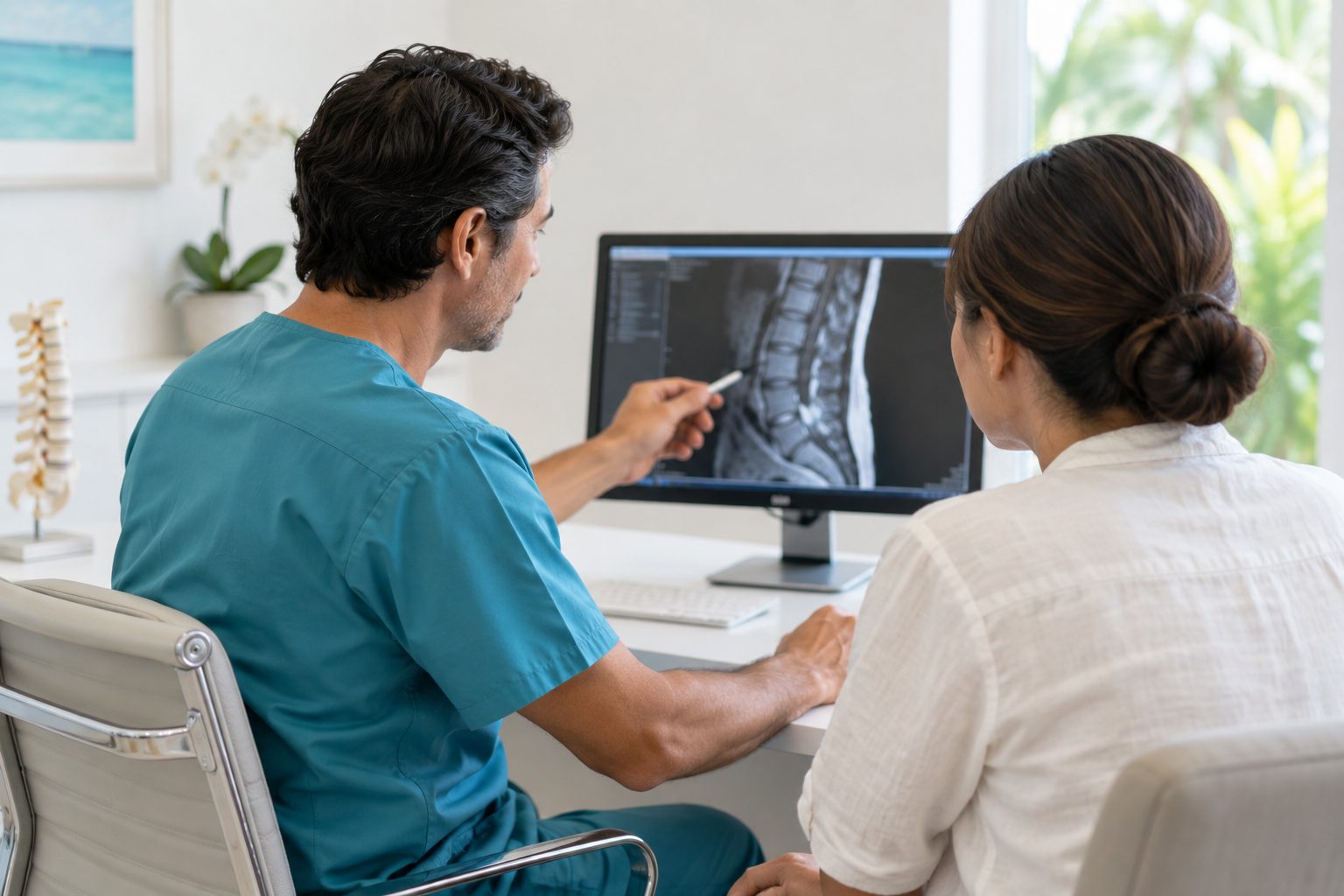
The specialist takes a detailed history, then examines neck movement, the muscles around the shoulder blade, and the power, reflexes and sensation in both arms. Gently extending and turning the head to reproduce arm symptoms helps confirm nerve involvement. The shoulder is checked too, because shoulder problems can mimic neck pain. X-rays are used after trauma or to assess degenerative change, while MRI is reserved for persistent nerve symptoms or before a procedure. For most people the plan is physiotherapy, a workstation review and a graded return to loading.
Warning signs that need prompt assessment
See a doctor without delay if neck pain comes with any of the following:
- Weakness in an arm or hand, or clumsiness such as dropping cups, struggling with buttons or a weakening grip.
- A change in balance or walking, or heaviness in the legs, which can mean pressure on the spinal cord.
- Neck pain after a fall, motorbike accident or any significant impact, especially with pain down the middle of the neck.
- Fever, severe headache and a stiff neck, particularly with light hurting your eyes.
- Unexplained weight loss, pain that wakes you every night, or new neck pain in anyone with a history of cancer.
Frequently asked questions
Is my pillow causing my neck pain?
A pillow rarely causes the problem alone, but the wrong height keeps it going by holding your neck bent all night. If you wake stiff and improve during the day, adjust pillow height first.
How long should neck pain last before I see someone?
Ordinary muscular neck pain usually settles within two to three weeks. Get it checked if it still limits you after four to six weeks, if it keeps returning, or if symptoms move into the arm.
Can neck pain cause headaches?
Yes. Pain from the upper neck joints and muscles often refers to the back of the head and behind the eyes, usually on one side, and these headaches tend to improve when the neck is treated.
Does a standing desk fix neck pain?
It helps mainly by breaking up long sitting. Standing still for hours with a low screen creates the same problem, so alternate between the two and keep the screen at eye level in both.
Getting it assessed
Most laptop-related neck pain settles once the setup and the movement habits change. If yours has lasted beyond a few weeks, keeps coming back, or has started travelling into your arm, have it examined properly. Our spine specialists consult at hospitals across Bali, and you can book a consultation or message the clinic on WhatsApp.
This article is general information, not medical advice. Any persistent or severe symptom should be assessed by a qualified orthopaedic specialist in person.